

When you clip the leash onto your dog, the two of you usually have very different goals in mind. You, being a simple human, might be looking forward to a peaceful walk—taking in the sights and sounds of a beautiful day. Or maybe you’re heading out for a jog, hoping to get your heart rate up and enjoy that runner’s high. Either way, your expectation is fairly straightforward: you and your dog will move together along a path, street, or sidewalk, in a relatively straight line, at a steady pace, politely ignoring distractions.
Your dog, however, has a completely different agenda.
Your dog is a highly skilled predator—a direct descendant of the wolf—and the moment you step outside, he’s hunting. What is he hunting? Anything that moves: a squirrel, a cat, another dog (perhaps a potential teammate), or even the presence of a perceived predator. Whether we label it play drive, prey drive, or fight/flight, it’s all part of one unified system. Your dog is seeking connection with his environment in a way that feels good—safe, grounded, purposeful, and in sync with those around him.
So how do we meet our dogs in that reality? How do we help a hunting-oriented animal feel satisfied while walking through a human world?
We give that drive somewhere to go.
If a dog doesn’t understand where to direct his energy, it will almost always flow away from you, the handler, and toward the environment. But if we capture that energy and give it a clear outlet, we can actually work with it instead of against it. One of the most effective ways to do this is by channeling that drive into a “preyful” object—something the dog can engage with that helps regulate and ground him emotionally.
Think about puppies for a moment. Like human babies, they explore the world with their mouths—everything goes in. This isn’t random. The gut, often called the “little brain,” is wired to take in not just food, but information. That oral engagement is how they connect with and understand their environment.
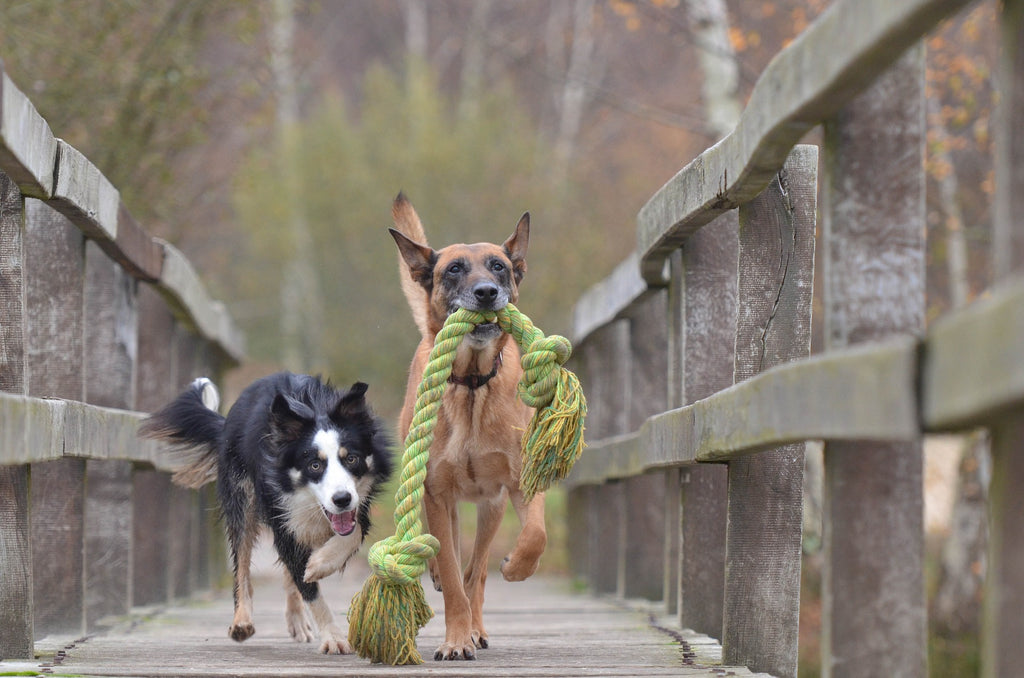
Now consider your adult dog. Does he love carrying toys around? Does he search for the perfect stick on a walk and proudly parade it down the trail? That behavior hasn’t disappeared—it’s evolved. When a dog carries an object, he’s engaging in a natural part of the predatory sequence known as “bite and carry,” also commonly called parading. This stage is deeply regulating. It allows the dog to feel organized, satisfied, and in flow with his environment.
This is why “bite-and-carry” work can be such a powerful tool on walks.
When you give your dog an appropriate object to hold, you provide a clear channel for all that energy. Suddenly, the same stimuli that might have caused lunging or reactivity—a squirrel, a passing dog, children, wildlife—can be processed through the object instead. The dog remains engaged, but grounded. He can stay connected to you while still fulfilling his instinctual needs.
I’ve found that when my dogs understand this game, everything changes. They learn that if they come when called, I will provide an outlet that satisfies their need to hunt, play, and engage. Whether it’s a squirrel, another dog, or even larger wildlife, that energy gets funneled into the object I control.
And ultimately, that’s what matters most to them.
If your dog can “hunt,” play, and process the world through an object that you provide and manage, you’re no longer competing with the environment—you’re becoming part of it. And that’s when your walks start to feel less like a struggle, and more like a partnership.